Our scores
- Design & build quality7.5/10
- Coffee taste8.6/10
- Ease of use7.2/10
- Maintenance7.8/10
- Value for money8.0/10
- Suitable for beginners6.5/10
Verdict
The Bialetti Brikka is an interesting moka pot for those who want to get close to espresso without a machine. The pressure valve produces a visible crema and a more intense taste, but demands more precision to use than a standard moka. Less suited for beginners, it is an excellent choice for lovers of intense coffee.
The Bialetti Brikka is Bialetti's "special" moka pot: it starts from the classic Moka Express design, but adds an internal valve system to build more pressure and create a layer of crema foam on the coffee. The result is a cup that looks and tastes more like espresso than an ordinary moka pot, with a noticeably fuller mouthfeel and a more intense flavour.
Design & how it works
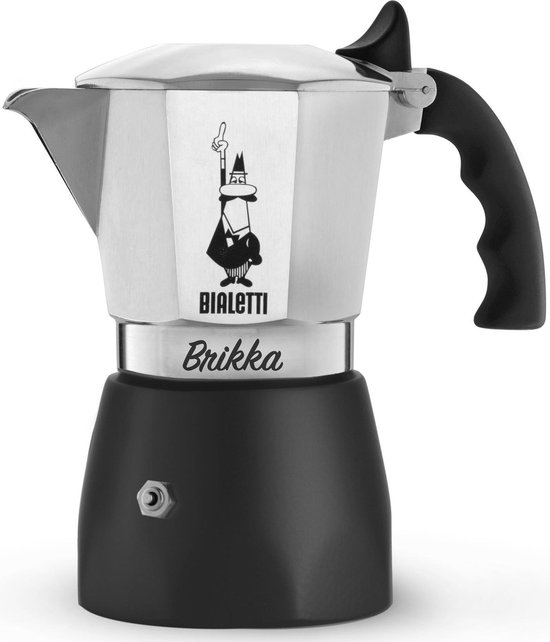
From the outside, the Brikka looks very much like a Moka Express, with an aluminium body, black base and black handle. The difference lies mainly inside: in the chimney of the upper chamber sits a special pressure valve that stays closed until sufficient pressure has built up. Once this threshold is crossed, the coffee "bursts" through the valve, generating a stronger jet, more turbulence and a layer of crema on the surface, comparable to what you know from pressurised filters in espresso machines.
The Brikka is available in 2-cup and 4-cup versions; the 2-cup makes about 100 ml and the 4-cup about 170 ml — a double espresso or lungo-sized portion. The moka pot is entirely die-cast aluminium and works on gas, electric and ceramic-glass hobs, but not directly on induction. Those with induction can use a separate adapter plate.
Coffee taste: more intense than an ordinary moka pot
The added value of the Brikka is in the cup. In comparative tests, it stands out as noticeably more intense than a standard moka pot: the coffee has more body, is creamier in the mouth and shows a visible crema layer, especially with freshly ground coffee and a dark roast. Many users describe the taste as closer to espresso than the Moka Express, and as an excellent base for cappuccinos and lattes, as the coffee holds its own through milk.
The trade-off is that the Brikka can be less forgiving with light roasts and overly aggressive heat: over-extraction and bitterness lurk more readily. Reviews indicate that dark to medium-dark roasts give the best results, while very light filter-style coffees can come out rather sour or sharp.
In practice: same ritual, more precision
You use the Brikka in practically the same way as an ordinary moka pot: water in the base, coffee in the filter basket, screw together and place on the heat. However, reviews call for a little more precision to get the best out of the moka pot. It is recommended to use the included measuring cup to measure the exact water amount to the mark, rather than filling "by eye" up to the valve. A relatively fine grind (close to espresso) and an even distribution in the filter basket, without tamping, are also often advised.
Heat control is crucial: reviews agree that a slow temperature rise on medium or even low heat gives far better results than high heat. As soon as the coffee starts flowing and you hear the first sputtering, ideally remove the Brikka from the heat or quickly cool the base under the tap to avoid overheating and burnt notes. Some users even deliberately aim for a slightly slower flow with less spectacular foam eruption, as this steady flow gives a smoother, more complex coffee.
Reliability, maintenance and known issues
Like other aluminium moka pots, the Brikka requires hand washing and some basic care. Rinsing with hot water after each use, cleaning the valve and chimney regularly, and replacing the rubber gasket in time are the key points. Cleaning is fairly quick; several reviews describe the Brikka as "very easy to clean" and appreciate the absence of extra parts apart from the valve itself.
However, user reviews and forums report that the valve can occasionally jam or behave inconsistently, especially in older or less well-maintained units. A stuck valve then leads to inconsistent volumes and flavour, or the absence of the promised crema. This is often resolved by carefully cleaning the valve and removing limescale, but it is a weaker point compared to the simplicity of a Moka Express with no additional mechanism.
Bialetti Brikka
See price on Amazon →| Brand | Bialetti |
|---|---|
| Model | Brikka |
| Material | Aluminium (classic model) |
| Capacity | 2 or 4 cups |
| Heat source | Gas and electric (induction with adapter) |
| Maintenance | Hand wash with hot water, keep valve clean and dry |
Who is the Bialetti Brikka a good choice for?
The Brikka is especially interesting if you already know you enjoy the moka flavour profile, but want to get closer to espresso without immediately investing in a machine. It is ideal for those who want intense shots with crema and who drink this coffee mainly straight or as the base for milk-based drinks. Those who enjoy playing with grind, heat and timing will also find a lot of satisfaction.
The Brikka is less suitable if you:
- are primarily looking for simplicity and do not want to fine-tune settings;
- often use light roasts and expect a very transparent flavour profile;
- have a large family and want to prepare large quantities at once, since the Brikka only comes in 2- and 4-cup versions.
For many enthusiasts, the comparison with the Moka Express concludes like this: the Brikka does not make objectively "better" coffee, but different coffee — creamier, stronger, more "espresso". If that is exactly what you are looking for, it is a very attractive upgrade; if you primarily want a simple and forgiving moka pot, the classic Moka Express remains the safer choice.
Bialetti Brikka vs alternatives
| Model | Material | Induction | Strength | Ideal for | Price |
|---|---|---|---|---|---|
| Bialetti Brikka | Aluminium | ✗ | Crema and espresso intensity | Advanced users and strong coffee lovers | ££ |
| Bialetti Moka Express | Aluminium | ✗ | Classic, bold moka taste | Traditional moka lovers, daily use | £ |
| Bialetti Fiammetta | Aluminium | ✗ | Simplicity and low entry price | Beginners who prioritise ease and price | £ |
| Bialetti Venus | Stainless steel | ✓ | Stainless steel, maintenance and induction | Modern kitchens and daily use | £££ |
Frequently asked questions
Does the Bialetti Brikka really produce more crema than other moka pots?
In our test, we clearly observed more crema than on classic models, provided the grind and dosing are correct. It is not yet a real espresso machine, but the difference is visible and perceptible in the mouth.
Is the Brikka harder to use than an ordinary Moka Express?
The basic routine is the same, but the Brikka is more sensitive to grind, quantity and heat. During our practical test, we noticed that beginners benefit from taking the time to find their "recipe", while experienced users quickly grasp the logic.
Does the Bialetti Brikka work on induction?
The classic aluminium Brikka does not work directly on induction. In our test we used an adapter to place it on an induction hob. If you want to work without an adapter, a stainless steel model like the Bialetti Venus is often more practical.
Is the Bialetti Brikka worth the price difference over other models?
For those who are primarily looking for maximum intensity and a clear crema layer, we found the price premium justified. If you are mainly looking for simplicity and a low entry price, models like the Fiammetta or Moka Express are more logical.
About the author
Timo Dekker
Timo started behind the bar of an Amsterdam café and became fascinated by how small differences in grind or heat can transform a cup of coffee. He now works primarily from home, testing Italian moka pots on gas, induction and electric hobs, from entry-level models to pricier design pieces. For Italian Moka Pot, he brings together these experiences in practical reviews and guides, so you know what a moka pot really does on your stove, not just in the product photo.
